
 English
 Español
 عربى

0-100000kg Professional Custom Lifting Platform
We have a professional team with decades of industry experience. Relying on the continuous in-depth development of the s...

Content
A warehouse operator in Rotterdam sends out a tender for twelve narrow-body electric scissor lifts: 10 m platform height, 230 V charging, a footprint under 1.2 m, and a non-standard side entry gate. Three quotations come back from China, all described as "custom." Only one includes a load chart, a deflection figure, and the name of the plant where the machine will be welded. That difference is what separates a real custom electric mobile lift work platform manufacturer from an export desk that forwards drawings to someone else.
So here is the short answer. When you screen China custom electric mobile lift work platform manufacturers, check four things in this order: the product families they actually build and stock parts for, the power and drive configurations they offer as standard rather than as favors, the fabrication equipment inside their own buildings, and the paperwork they can hand over for certification, testing, and after-sales response. Price is the last variable, not the first.
The word custom appears in two very different forms, and mixing them up is the most common sourcing mistake.
Configuration custom should be quoted in days. Engineering custom takes weeks and should arrive with calculations. A manufacturer that owns a separate product category for non-standard lifts is usually the safer counterpart for the second type. Huzhou Mobile Lift Equipment Co., Ltd., for example, runs a dedicated professional custom lifting platform line alongside its standard scissor and mast products, which means non-standard work sits inside the normal production flow instead of being outsourced.
Model depth is the fastest way to judge a supplier. A factory listing eight semi-electric scissor models across roughly 5 m to 16 m of platform height is working from a shared chassis architecture, which means shared hydraulic components, shared controllers, and spare parts that stay available after the warranty window closes.
Ask specifically for platform heights and rated loads per model rather than one headline figure, whether the chassis is shared across the range, battery capacity and expected runtime per charge, and the wheel and steering configuration, which often decides whether the machine fits the aisle at all.
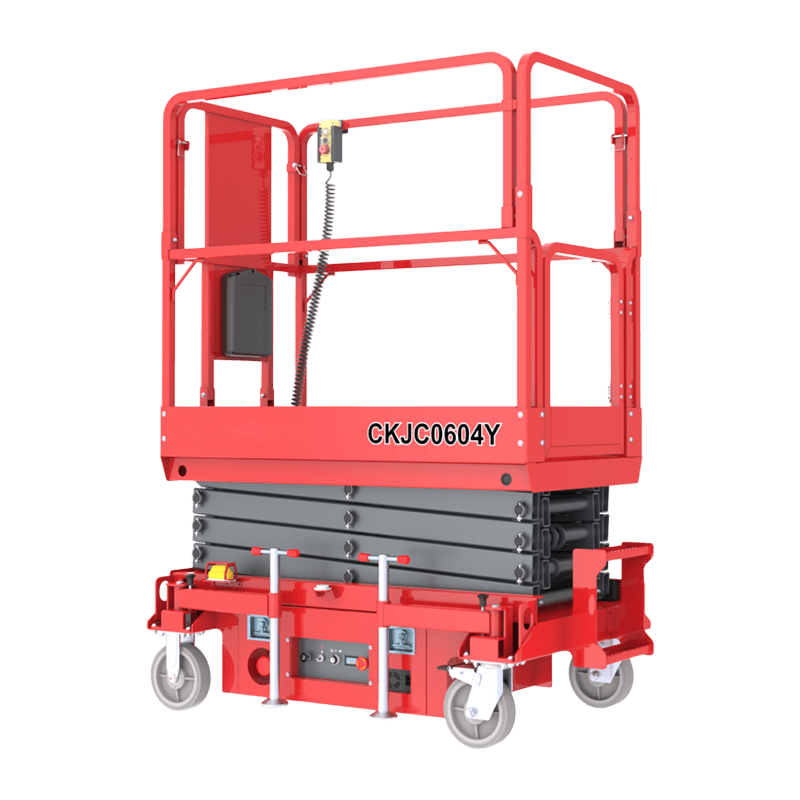 Semi-Electric Scissor Lift Platform Series CKJC0503Y to CKJC1614YEight semi-electric scissor lift platform models with manual propulsion, electric lift, telescopic platforms, folding guardrails, and controls suited to fixed-position engineering decoration work.View Product →
The semi-electric scissor series above is a useful reference point: eight models on one platform family, with manual propulsion and electric lift, suited to work where the charging point is fixed and travel distances are short.
| Configuration | Drive and steering | Best-fit work | Check before ordering |
|---|---|---|---|
| Semi-electric scissor lift | Manual push, electric lift | Fixed-position maintenance and installation | Floor slope, pushing force on ramps, charger location |
| Mini electric hydraulic steering scissor lift | Self-propelled, hydraulic steering | Corridors and mixed indoor floors | Turning radius, ground clearance |
| Mini electric scissor lift with universal wheels | Self-propelled, multi-directional wheels | Cramped plant rooms, retail, service work | Wheel wear on rough concrete, threshold heights |
| Narrow-body electric scissor lift | Self-propelled, compact chassis | Warehouse aisles, mezzanine access | Aisle width, door opening, deck extension load |
| Self-propelled full-electric reclaimer | Self-propelled, mast-based | High racking, stock retrieval, cycle counting | Rack beam spacing, lift height, aisle guidance |
Two practical numbers decide most of these choices: aisle width at the tightest point, including any door frame or column, and the floor's rated point load. A platform that fits the aisle but overloads a suspended slab is a rejected machine, not a bargain.
For non-standard platforms, the deliverable list matters more than the machine photo. Ask for a load chart, a structural calculation covering the platform and the scissor stack or mast, a stated deflection limit under rated load, a functional test protocol, and the surface treatment specification. A manufacturer running its own 300 t CNC press brake, high-power laser cutting, and an integrated paint, powder and e-coat line can hold those tolerances in-house; one that subcontracts fabrication cannot guarantee them across repeat orders.
The difference between a genuinely engineered custom lift and a modified standard machine is covered in more depth in this guide to custom lifting platform types and mechanics.
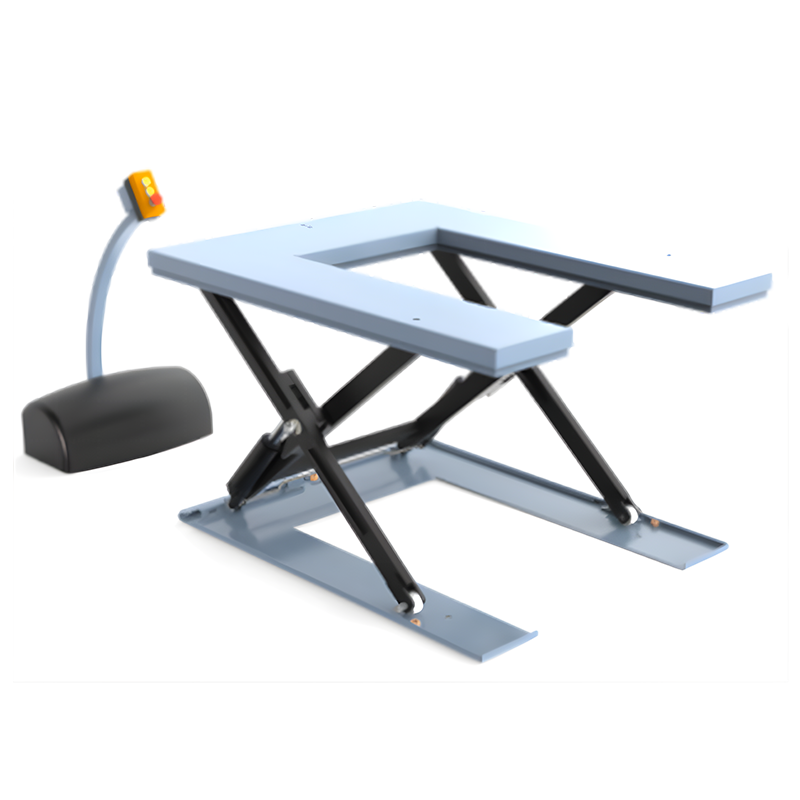 Professional Custom Lifting Platform with 0 to 100,000 kg CapacityCustom heavy-duty scissor lifting platform for high-precision, synchronized lifting, with intrinsically safe wiring for explosion-proof scenarios and adaptable control interfaces.View Product →
Site visits are not always practical, so build a paper picture instead. A shortlisted manufacturer should answer the following without hesitation:
Also ask for the total site area and the roofed factory area. A supplier working from roughly 40,000 m² of land with about half under roof is running a real plant; a supplier that cannot state its building footprint may be assembling from purchased frames.
Warehouse machines follow different rules from construction-site lifts, because they work inside a fixed layout every day. For high racking and stock retrieval, a self-propelled full-electric high-altitude reclaimer is normally the better choice than a converted order picker: it is designed for repeated cycles, carries a rated platform load for stock, and its mast stability is engineered for standing work rather than occasional access.
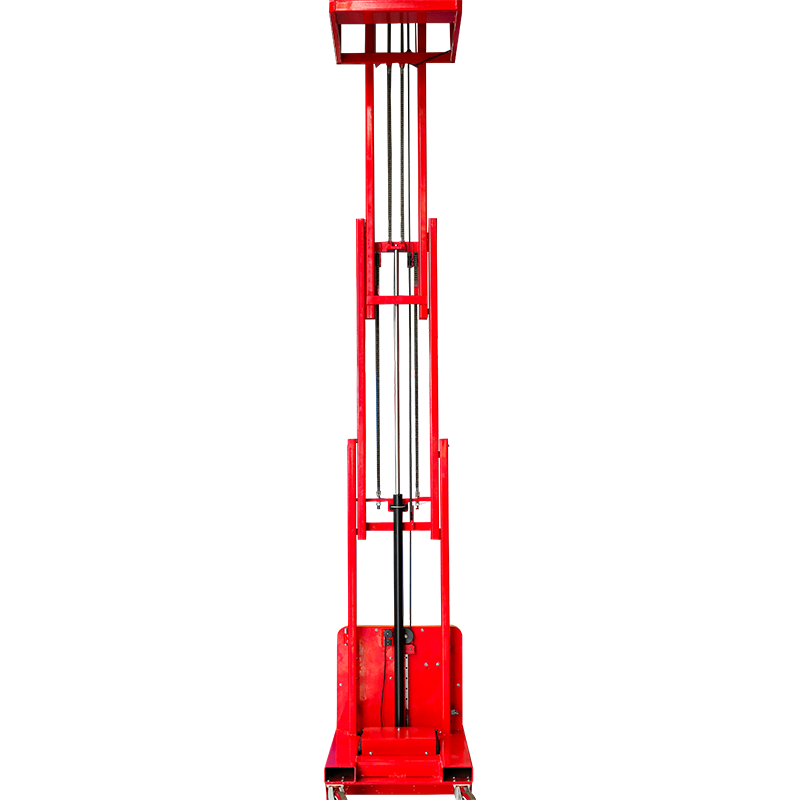 Self-Propelled Full-Electric High-Altitude Reclaimers CKOP30 to CKOP45Warehouse reclaimers with electric lift, travel, and steering, 0-degree turning radius, and controls for repeated material picking in narrow aisles and racking.View Product →
Related options in the same category include half-electric reclaimers for sites without dependable charging infrastructure, and mobile stock pickers in 3 m and 4 m versions for lower racking and faster picking cycles. The deciding factors are racking height, the load carried back down, and the number of cycles per shift.
Most sourcing problems in this category come from unclear inputs rather than dishonest suppliers. Manufacturers build what the drawing says; if the drawing never mentioned a 1.1 m door frame or a mezzanine rated at 350 kg/m², the delivered machine will still be correct on paper and unusable on site.
Give a Chinese electric mobile lift work platform manufacturer precise constraints, ask for the calculation behind every custom part, and verify the fabrication equipment that will actually touch your order. The suppliers that answer those three requests with documents instead of adjectives are the ones that ship machines that fit.
We have a professional team with decades of industry experience. Relying on the continuous in-depth development of the s...
The mini electric mobile scissor lift with universal wheel integrates lifting, walking and operation functions. It adopt...
The CKJC0705EH CKJC0604EH CKJC0503EH mini electric hydraulic steering mobile scissor lift is designed for efficient oper...
The hydraulic self-propelled scissor lift aerial work platform can be easily driven and moved on flat and solid ground a...